




A little more brains and a little less brawn. That’s the direction Dodge is seeking to go with the Challenger, one of the staples of the brand that has thundered across American roadways for over 50 years. Dodge announced in 2022 that the 2023 model year would be the final ride for the gas-powered Challenger, marking the end of an era for the iconic muscle car. But we expect the spirit of the Challenger, and perhaps even the name itself, to live on in the form of the first electric muscle car coming to a dealership near you in 2024.
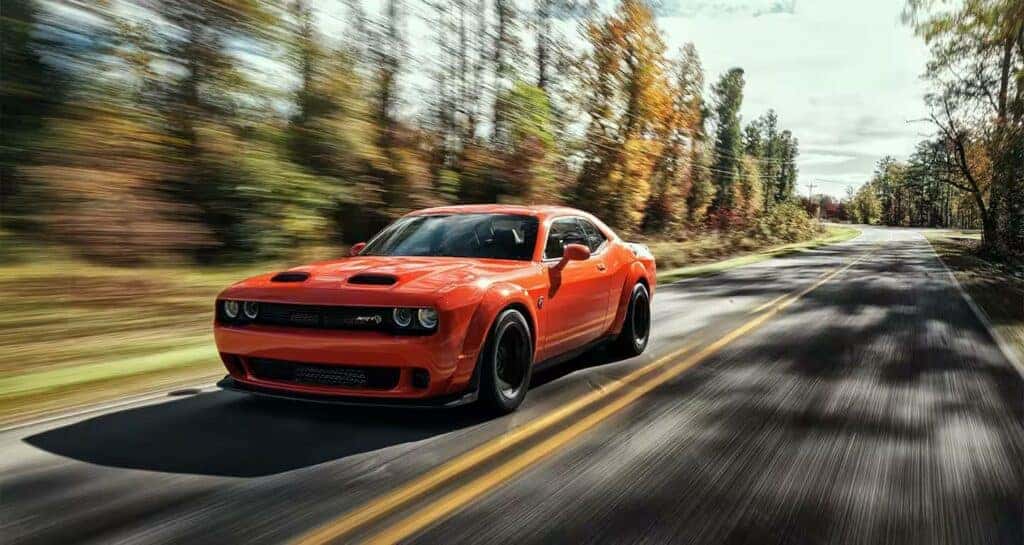
Read below for more information about why Dodge is discontinuing the gas-powered version of the Challenger and what’s in store for the future of the brand.
Why Is Dodge Discontinuing the Challenger?
To be clear, Dodge is officially only discontinuing the gas-powered Challenger fueled by its famous HEMI engine. Dodge made clear its intention to unveil an electric-powered muscle car in 2024 with the rollout of the electric Charger Daytona SRT concept car in the fall of 2022. And there’s speculation within the industry that the brand’s electric lineup may include more than one model and that one of those models may be donned with the Challenger name.
At the root of the decision to put an end to the HEMI-powered Challenger is Dodge’s commitment to electric cars and what the brand believes is the future of American driving.
The automotive industry is experiencing a seismic shift as concerns about fossil fuels and climate change persist, gas prices soar, and an increasing number of Americans are turning to hybrid and electric alternatives. There are tax credits for consumers who purchase electric vehicles and even legislation in the works in a number of states aimed to curb the sale of gas-powered cars in years to come.
As a result, practically every major manufacturer has at least one alternative-fuel model in its lineup. Dodge introduced its first plug-in hybrid, the Hornet, for the 2023 model year. And Dodge’s parent company, Stellantis, is investing $99 million in manufacturing plants for electric engines and batteries. It may not be long before you’re humming around Cortlandt in an electric Dodge muscle car.
The Challenger is not the only Dodge muscle car to undergo such a transformation either. The Challenger’s sibling, the Charger, is also being discontinued in its gas-powered form after 2023. And like the Challenger, the Charger is also expected to be reinvented as an electric car and ready to hit the pavement in 2024.
The 2023 Dodge Challenger
After looking ahead to the future but before reflecting on the past, let’s focus on the present. Instead of a funeral, Dodge has thrown a celebration of life for the Challenger. Because 2023 represents the final model year of the current Challenger, Dodge has pulled out all the stops and issued a “Last Call” badging for this year’s class. Special edition models feature a plaque under the hood, and Dodge returned several previously retired colors to the 2023 palette.
Here are the six different special edition builds of the Challenger available in the 2023 model lineup:
- Demon 170.
- Black Ghost.
- Shakedown.
- Swinger.
- 345 R/T.
- Blacktop.
The Demon 170 is the highlight of the bunch and can achieve 1,025 horsepower with the help of Dodge’s famous Hellcat V-8 engine. Dodge is only planning to produce 3,300 of these cars, with 3,000 of them going to the U.S. market.
These are the non-special edition Challengers in the 2023 lineup:
- SXT.
- GT.
- R/T.
- R/T Scat Pack.
- R/T Scat Pack Widebody.
- SRT Hellcat Jailbreak.
- SRT Hellcat Widebody Jailbreak.
- SRT Hellcat Redeye Jailbreak.
- SRT Hellcat Redeye Widebody Jailbreak.
- SRT Super Stock.
The base-level SXT generates 303 horsepower, while the SRT Super Stock tops out the lineup at 807 horsepower and 707 lb-ft of torque.
The History of the Challenger
Dodge introduced the first Challenger in the fall of 1969 for the 1970 model year, and it featured the industry’s first molded polypropylene door panels. There were two trims available during the initial launch, a standard, and an R/T, both of which came available in a coupe or convertible. The standard Challenger sold for just $2,850. Dodge’s famous HEMI engine was along for the ride from the get-go, and the first Challengers to leave the assembly line did so with a maximum of 425 horsepower. This first generation of Dodge Challengers lasted through 1974.
After a brief hiatus, Dodge introduced a second generation of Challengers in 1978 and they continued through 1983. These Challengers merged away from the classic muscle car design toward a sportier feel and featured less powerful engines than their predecessors.
Dodge then shelved the Challenger line for 25 years before reintroducing it in 2008. This third generation of the Challenger has continued to the present day and pays homage to the muscle car vision of the original Challenger.
In 2021, the Dodge Challenger topped longtime rivals such as the Ford Mustang and Chevy Camaro to become the best-selling muscle car in the U.S., a title the model then repeated in 2022. The Challenger also won an Automotive Loyalty award from IHS Markit in 2022, recognizing the model’s ability to keep customers within the Dodge brand. Clearly, the Challenger has proven to be a popular muscle car, and the 2023 model should be thought of as the beginning of a new era instead of the end of an old one.
Ready To Meet the New Dodge Challenger?
2023 marks your last opportunity to drive home in a brand-new Dodge Challenger in the form we’ve always known it. Check in with us here at Bill Volz Westchester to see our inventory of 2023 Dodge Challengers for sale in Cortlandt, New York. And don’t forget to shop our inventory of used Dodge vehicles for sale for additional options for the Challenger, Charger, and other exciting vehicles. Apply for financing today, and visit us on Crompond Road in Cortlandt to test-drive some Dodge Challengers and learn more about the present — and future — of this American icon.
Photo Credit: Image used via OEM
Connect with us


- July 2026
- June 2026
- May 2026
- April 2026
- March 2026
- February 2026
- January 2026
- December 2025
- November 2025
- October 2025
- September 2025
- August 2025
- July 2025
- June 2025
- May 2025
- April 2025
- March 2025
- February 2025
- January 2025
- December 2024
- November 2024
- October 2024
- September 2024
- August 2024
- July 2024
- June 2024
- May 2024
- April 2024
- March 2024
- February 2024
- January 2024
- December 2023
- November 2023
- October 2023
- September 2023
- August 2023
- July 2023
- June 2023
- May 2023
- April 2023
- March 2023
- February 2023
- January 2023
- December 2022
- November 2022
- October 2022
- September 2022
- August 2022
- July 2022
- June 2022
- May 2022
- April 2022
- March 2022
- February 2022
- January 2022
- December 2021
- November 2021
- October 2021
- September 2021
- February 2017
- January 2017
- December 2016
Archives
- Advice
- Challenger Tips
- Chrysler
- Chrysler Features
- Chrysler Service Tips
- Chrysler Tips
- Dodge
- Dodge Charger
- Driving Tips
- Electric Vehicles
- Financing
- Jeep Compass
- Jeep Lineup
- Jeep Owner Tips
- Jeep Tips
- Jeep Wrangler
- Local
- Local Cafes
- Local Shops
- Mopar
- Ram Trucks
- Service Tips
- Uncategorized
- Used Vehicles
- Vehicle Upkeep
- Wagoneer